Posts mit dem Label wind werden angezeigt. Alle Posts anzeigen

Mittwoch, 20. Dezember 2017

The demand for pumped storage facilities in central Europe

The demand for pumped storage facilities in central Europe 

IIn the year 2017 I was at two pump storage plant meetings,"Pumpspeicherwerke" in Essen on July 10,2017 and on November 29/30 at the 3rd International Pump Storage Conference in Salzburg, the results are somewhat contradictory and I want to discuss them in this blog post.

(This article about pumped storage was first posted in German language and was translated with the help of deepl.com)

International distribution of pumped storage power plants.

Pumped storage in Germany

The German pumped storage facilities have a capacity of 40 gigawatt-hours and a connected load of 6 GB,  these are enormous figures but in relation to the electricity system they are rather small, the power capacity is about one-tenth of the German electricity consumption and the energy capacity could supply Germany with electricity for less than an hour (if the power capacity were sufficient).

The task of the pumped storage plants in their original function, however, was not to supply Germany with electricity overnight if the sun doesn't shine, but to manage failures of nuclear power plants or to cover peak loads during the lunchtime period, which were caused by switching on many electric cookers in earlier days.

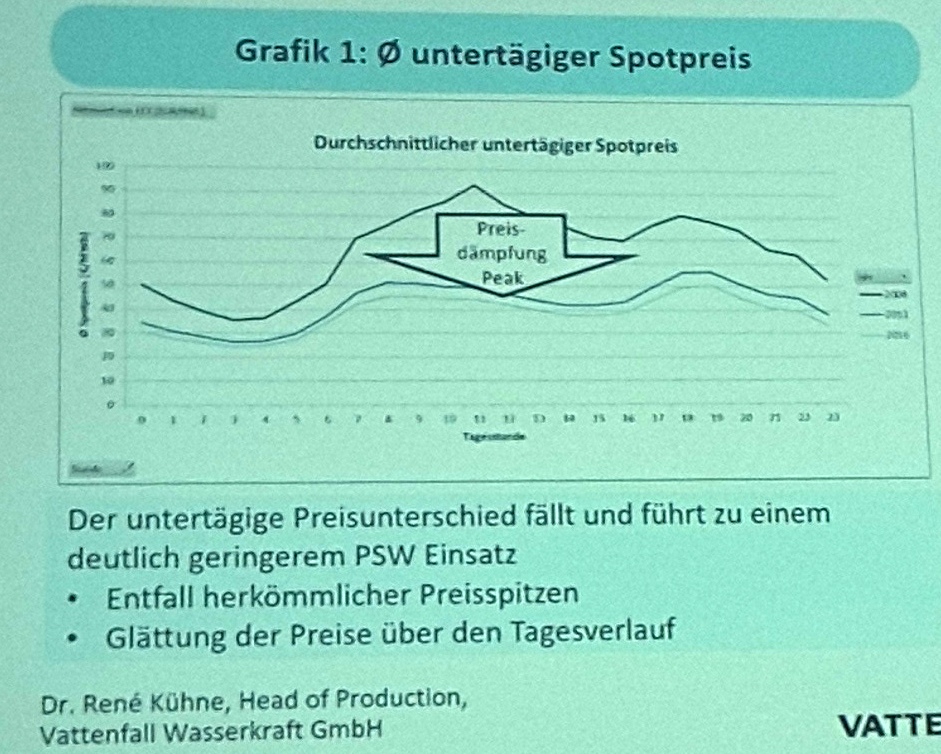
Rene Kühne on the development of the spot price, the peak at noon has disappeared. (Slides)

Today the picture has changed massively. During the day, the high number of photovoltaic systems, with around 40 GB of installed capacity in Germany, makes a significant contribution to the reduction of electricity demand peaks. Although not always, especially in the winter when it is very cloudy and only a few hundred megawatts are generated by photovoltaics. As a result, the price of electricity no longer fluctuates as much as in the past, which is precisely why pumped storage operators have a major problem financing their systems.

It is now the case that even finished plants can hardly generate the revenues to maintain operation. At the meeting in Essen, for example, some spokespersons stated that in the event of a major overhaul, such as the replacement of a turbine, the power plant would actually have to be shut down for economic reasons.

This would, of course, have considerable consequences for the electricity grid, because the pumped storage facilities are also used to stabilize the grid and are supposed to buffer solar and wind power in the future in order to provide the corresponding energy at other times of demand.

A new building is therefore practically unthinkable in Germany, which also meant that the well-known Atdorf project in the southern Black Forest was stopped, although 60 million euros have already been spent on planning.


Expansion of the pumped storage power plants has almost come to a standstill, shown as yellow circles, Reinhard Fritzer, ILF (Slides)

Pumpspeicher in ÖsterreichPumped storage in Austria

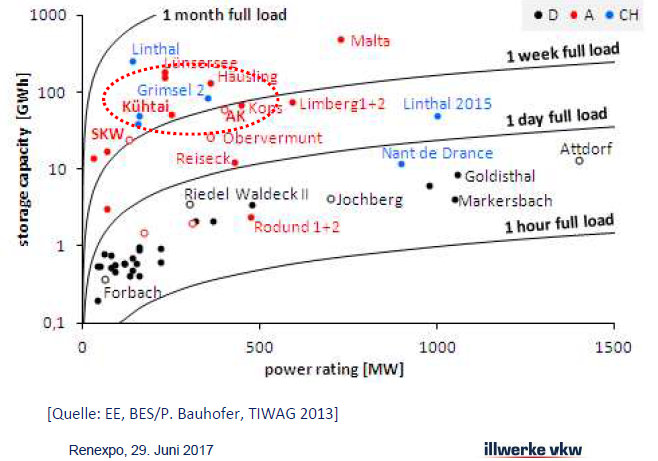
The situation is different in Austria, where there are considerably more pumped storage power plants, especially in terms of storage capacity. This comes from the large slopes in the Alps around the much larger dams and thus reservoirs.

Professor Helmut Jaberg's famous plant of the Illwerke was presented at the International Pumped Storage Storage Conference in Salzburg. A pumped storage tank with a drop height of more than 800 m and over one gigawatt of power.


The ratio of stored energy to turbine power is larger in Austria and Switzerland, which means that its energy can be stored for longer periods.
Due to the large storage energy capacity, surpluses such as those from longer periods of strong wind can also be absorbed if the lines are sufficient. In times of calm, the energy can then be called off and sold at higher prices.

This is often misleadingly portrayed in the media as if Germany is giving electricity away abroad and reimporting it at great expense. No, there is a service in between that the energy is stored and delivered exactly when we need it!

Storage revenue sources

The very flat price curve for electricity cannot currently finance storage facilities, but there are other sources of revenue for storage facilities, such as balancing the grid. Energy is provided or absorbed at short notice to stabilize the grid.

Control energy is another source of revenue for pumped storage.

In the lecture of the consulting firm BET from Aachen, additional sources of income were presented.

The problem, however, is often the legal regulations, which make it very difficult to treat all markets fairly. This often shows that our energy laws are still too much dominated by the way of thinking in the old energy system. In addition, the transport of energy is not shown, all prices are valid for Germany, although there may be a surplus in Northern Germany and a shortage of electricity in Southern Germany.

The load gradients have been growing in recent years, so fast control power is required.
An alternative to storage is the expansion of the grid, but unfortunately, this is progressing very slowly, so that in the long term a lot of energy coming from wind and sun does not reach the consumer.
Network expansion, only 3% are completed in 2016, Slide Team Consult.

Conclusion

Considering pumped storage alone in a power system does not make sense. In the future, all components of a modern power grid will have to work together. Wind, offshore and onshore, PV, power lines, storage facilities in Germany but also across the border and with fair rules for everyone involved.


Sonntag, 8. November 2015

Intercontinental Energy Grid

The Vision of China State Grid

The energy production in the future will be based on wind an solar power. Even in a carbon-rich power production country, like China, there is no doubt about this long-term development.
At the Dii conference 2015 in Dubai, I learned in the presentation given by Han Jun, Senior Vice President, State Grid Company of China, that a global energy grid can solve the problem of intermittent power production.
State Grid China, the vision of a global electricity balance

  Is a global grid possible

The idea, to have a global grid is simple, but the physical hurdles are hard to overcome. The best solution would be, we take a high-temperature superconductor and span the globe with this type of grid. The only remaining problem is, we don't have the technology, and although "high-temperature superconductor" (Working at -130°C not high in everyday experience) have been discovered 1986 by Georg Bednorz and K. Alex Müller at the IBM laboratory. Till today it was not possible to construct a power line on the base of this very brittle material.

Knowing this, the only path, in reality, is the use of high voltage direct current connections. And it has been shown by Chinese engineering, that the power connection between the three gorges dam and the 2,600 km distant city of Shanghai works to transport 7.2 GW of electricity.

Knowing this, we can try to calculate the necessary equipment to transport the power of wind and solar energy around the globe by conventional technology. 

How much power?

The first question concerns the amount of power that has to be delivered to far apart regions and continents. Today, a conventional power fleet of 5300 GW produces electricity where the consumers live. In a renewable future, this will still be true in some part for solar and wind, but it might be necessary to transmit 10% over very far distances. This would require a power line, able to transport about 600 GW and with a length of 10,000 km. 

These assumptions are very rough, but it is helpful to start with a plausible range, additional demands are then simple multiplications of the result. If we assume that the power line has a voltage of one million Volts, the current through this line is 600,000 Ampere and we don't want to lose more than 20% of the energy within the line. 

With these assumptions, the resistance of the line has to be in the range of R=U/I = 200kV/600kA = 0,3 Ohm. Knowing this, we can lookup in the table of material properties the necessary material demand. Only cooper and aluminum seem to be sufficient, aluminum is much cheaper, so we take aluminum. The electrical resistance of aluminum is 28.2 nΩ·m. The diameter of the 10,000,000 m wire has therefor 1 m², quite thick, but able to transport a significant amount of our global electricity demand on an intercontinental distance.
Sources of electricity in the year 2050, estimated by China State Grid.

How expensive is that cable?

To get an idea of the price, we have to know the raw material price of aluminum. At the moment, aluminum sells for 2000 $/t, with limited deviations from that value. Our power line needs 27.000.000 tons of aluminum because the density is 2700kg/m³. The price tag is 14 G$, not that bad if we consider the impact on the global power supply.
A real cable will be at last ten times as expensive as this first assumption because we have to include an isolation, that can keep one million Volt, but even a price of 140 Billion $ is small compared to the equipment, that is necessary to produce the power.

To produce 600 GW of power, even the cheapest wind power converter at the best suitable places around the arctic circle would cost 600 Billion $.

Impact of a global Grid

A global grid would be a tremendous step to a reliable energy supply. We can compare the solution with the alternative path of large-scale storage. The necessary storage for 600 GW over 10 hours needs a capacity of 6000 GWh. This could be done by ultra-cheap Lithium Batteries with a price tag of 300$/kWh or 1,800 Billion $ for the required amount. Using the Hydraulic Rock Storage HRS technology, the price could be reduced to 600 G$.

A global grid would use the oceans to wire the continents. The ocean floors are a relatively safe place to wire the world, as we already know from the internet fiber optic cables. Another advantage is the international law, the floor of the ocean is not under the same dispute as for the land surface and it seems much easier to get a permit to roll out the cables there.

When a country like China takes the lead to interconnect the continents with electric cables, this would change the way, we think about the local generation of power. But keep in mind, today, our energy supply system is intercontinental over the ocean, the supertankers distribute comparable amounts of energy over the ocean.