The demand for pumped storage facilities in central Europe
IIn the year 2017 I was at two pump storage plant meetings,"Pumpspeicherwerke" in Essen on July 10,2017 and on November 29/30 at the 3rd International Pump Storage Conference in Salzburg, the results are somewhat contradictory and I want to discuss them in this blog post.
(This article about
pumped storage was first posted in German language and was translated with the help of
deepl.com)
 |
| International distribution of pumped storage power plants. |
Pumped storage in Germany
The German pumped storage facilities have a capacity of 40 gigawatt-hours and a connected load of 6 GB, these are enormous figures but in relation to the electricity system they are rather small, the power capacity is about one-tenth of the German electricity consumption and the energy capacity could supply Germany with electricity for less than an hour (if the power capacity were sufficient).
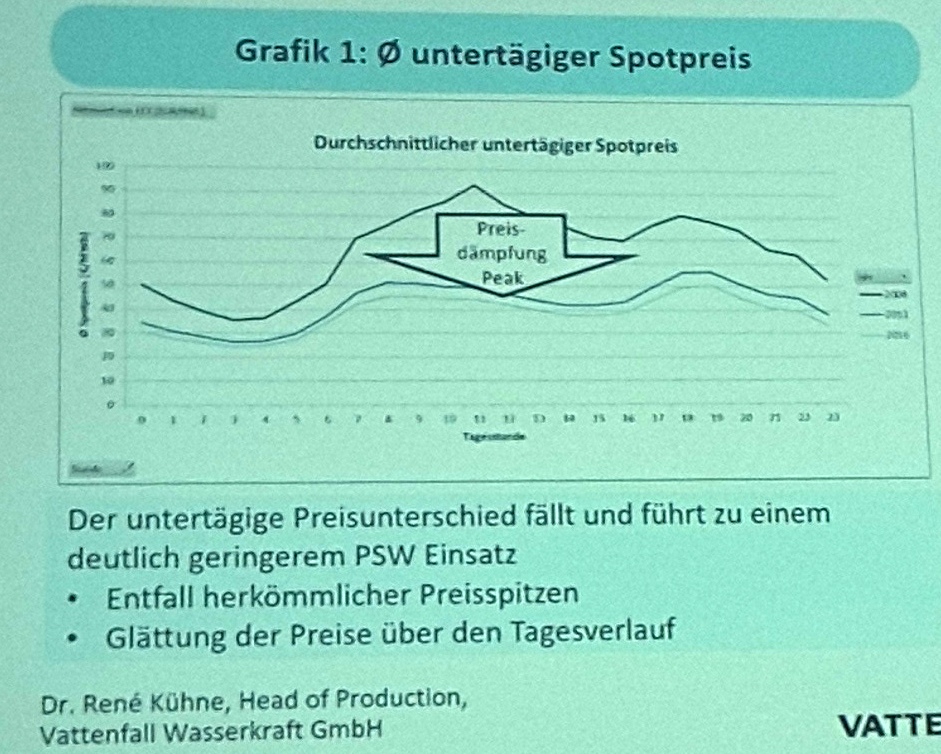
The task of the pumped storage plants in their original function, however, was not to supply Germany with electricity overnight if the sun doesn't shine, but to manage failures of nuclear power plants or to cover peak loads during the lunchtime period, which were caused by switching on many electric cookers in earlier days.
 |
| Rene Kühne on the development of the spot price, the peak at noon has disappeared. (Slides) |
Today the picture has changed massively. During the day, the high number of photovoltaic systems, with around 40 GB of installed capacity in Germany, makes a significant contribution to the reduction of electricity demand peaks. Although not always, especially in the winter when it is very cloudy and only a few hundred megawatts are generated by photovoltaics. As a result, the price of electricity no longer fluctuates as much as in the past, which is precisely why pumped storage operators have a major problem financing their systems.
It is now the case that even finished plants can hardly generate the revenues to maintain operation. At the meeting in Essen, for example, some spokespersons stated that in the event of a major overhaul, such as the replacement of a turbine, the power plant would actually have to be shut down for economic reasons.
This would, of course, have considerable consequences for the electricity grid, because the pumped storage facilities are also used to stabilize the grid and are supposed to buffer solar and wind power in the future in order to provide the corresponding energy at other times of demand.
A new building is therefore practically unthinkable in Germany, which also meant that the well-known Atdorf project in the southern Black Forest was stopped, although 60 million euros have already been spent on planning.
 |
| Expansion of the pumped storage power plants has almost come to a standstill, shown as yellow circles, Reinhard Fritzer, ILF (Slides) |
Pumpspeicher in ÖsterreichPumped storage in Austria
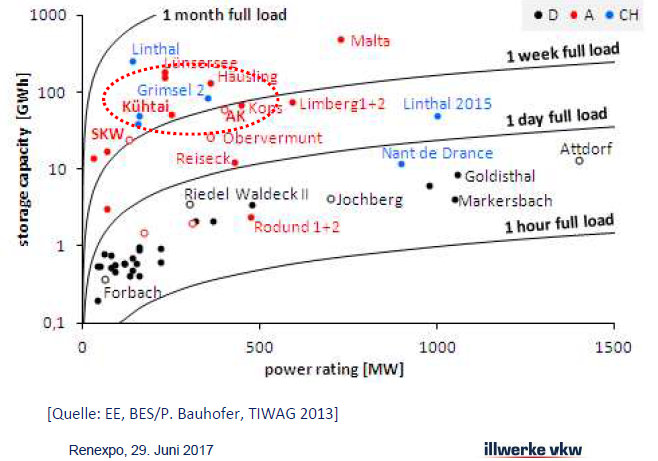
The situation is different in Austria, where there are considerably more pumped storage power plants, especially in terms of storage capacity. This comes from the large slopes in the Alps around the much larger dams and thus reservoirs.
Professor Helmut Jaberg's famous plant of the Illwerke was presented at the International Pumped Storage Storage Conference in Salzburg. A pumped storage tank with a drop height of more than 800 m and over one gigawatt of power.
 |
| The ratio of stored energy to turbine power is larger in Austria and Switzerland, which means that its energy can be stored for longer periods. |
Due to the large storage energy capacity, surpluses such as those from longer periods of strong wind can also be absorbed if the lines are sufficient. In times of calm, the energy can then be called off and sold at higher prices.
This is often misleadingly portrayed in the media as if Germany is giving electricity away abroad and reimporting it at great expense. No, there is a service in between that the energy is stored and delivered exactly when we need it!
Storage revenue sources
The very flat price curve for electricity cannot currently finance storage facilities, but there are other sources of revenue for storage facilities, such as balancing the grid. Energy is provided or absorbed at short notice to stabilize the grid.
 |
| Control energy is another source of revenue for pumped storage. |
In the lecture of the consulting firm BET from Aachen, additional sources of income were presented.
The problem, however, is often the legal regulations, which make it very difficult to treat all markets fairly. This often shows that our energy laws are still too much dominated by the way of thinking in the old energy system. In addition, the transport of energy is not shown, all prices are valid for Germany, although there may be a surplus in Northern Germany and a shortage of electricity in Southern Germany.
 |
| The load gradients have been growing in recent years, so fast control power is required. |
An alternative to storage is the expansion of the grid, but unfortunately, this is progressing very slowly, so that in the long term a lot of energy coming from wind and sun does not reach the consumer.
 |
| Network expansion, only 3% are completed in 2016, Slide Team Consult. |
Conclusion
Considering pumped storage alone in a power system does not make sense. In the future, all components of a modern power grid will have to work together. Wind, offshore and onshore, PV, power lines, storage facilities in Germany but also across the border and with fair rules for everyone involved.