Posts mit dem Label storage werden angezeigt. Alle Posts anzeigen

Samstag, 14. April 2018

Big Picture of Energy Generation 2030

Electric Energy Generation till 2030

We can read every day about the change in the energy market. We hear about the year 2050, a time when most of our politicians are no longer with us. 
But is the Big Change to renewables so far away? 
There is only one way to understand the change, and that is, read the data we have. And I did this and present them here. The source is from BP energy statistics, you can download the data there.

Solar and Wind

I concentrate on two sources of energy solar power and wind power. Both are renewable and have the potential to power our civilization. I take the sum of both to get a more smooth picture because there is some change between wind and solar shares, that obscure the real change. The result in a logarithmic graph can show us the long-term trend:
Figure 1: (click to enlarge) red: global electric power consumption; blue: global installed solar and wind power; yellow: global mean power from solar and wind. Data source: BP

The mean global electric energy consumption is about 2000 GW, shown as the red dots, which align in the plot and show a constant growth of 3%.

All installations of wind and solar power are shown as blue dots and have an astonishing constant growth over the last 20 years in the range of 22% per year. 

The mean energy production of this fluctuating sources is much smaller as the installed capacity due to the fact, that the sun does not shine at night and the wind does not always blow. A good estimate based on data from BP shows a factor of five between the blue and yellow line. This means the wind and solar production is only 20% of the time as strong as on the nameplate. Of course, this is a statistical value and may differ between different installations.

The most interesting point is somewhere at 2030, the yellow line crosses the red line, in other words, the generated electric energy over one year from solar and wind power is larger than the electric demand in 2030!

Could this be true  

Today (end 2017), only 2% of the global electricity is from solar power, but remember only 1% was from solar power 3 years ago. In 2020 we will see 4%, 2023 we see 8%, 2026 there are 16% and 2029 32% and 2032 64%, this is the rule of exponential growth, as we all have seen in electronics. 

Figure 2: Solar energy share in different countries and the world. Source: IEA PVPS, shown in pv-magazin.

The remaining 36%, oh sorry I did not include wind power in this very short estimation!

But there is one thing, that may stop this trend. It is not the price of photovoltaics because photovoltaics is now below 3ct/kWh and thereby cheaper than any other energy source. There is a so-called learning curve that gives in the future even lower prices due to high production volumes.

The roadblock could be energy storage!

If we find no way to store the energy cheap and on the huge scale, we cannot go far beyond 50% of fluctuating renewable energy in the electric grid. And the storage demand is in the range of 24 h global electricity production, 60,000 GWh!

To imagine this number using batteries, think about the Gigafactory built by Elon Musk. If it reaches full capacity it may supply 100 GWh of batteries a year. If we install all the batteries in the grid, we need 600 years until we have enough storage. This works only out when the batteries have a lifetime of at least 600 years. 
Figure 3: Gravity Storage, a large-scale electricity storage system.

We need new ideas, my concept of a Gravity Storage may show a way out of this problem. One Gravity Storage site can store up to 8 GWh of energy, and we don't need expensive raw materials only rock and water.

But this is another story. 


Mittwoch, 20. Dezember 2017

The demand for pumped storage facilities in central Europe

The demand for pumped storage facilities in central Europe 

IIn the year 2017 I was at two pump storage plant meetings,"Pumpspeicherwerke" in Essen on July 10,2017 and on November 29/30 at the 3rd International Pump Storage Conference in Salzburg, the results are somewhat contradictory and I want to discuss them in this blog post.

(This article about pumped storage was first posted in German language and was translated with the help of deepl.com)

International distribution of pumped storage power plants.

Pumped storage in Germany

The German pumped storage facilities have a capacity of 40 gigawatt-hours and a connected load of 6 GB,  these are enormous figures but in relation to the electricity system they are rather small, the power capacity is about one-tenth of the German electricity consumption and the energy capacity could supply Germany with electricity for less than an hour (if the power capacity were sufficient).

The task of the pumped storage plants in their original function, however, was not to supply Germany with electricity overnight if the sun doesn't shine, but to manage failures of nuclear power plants or to cover peak loads during the lunchtime period, which were caused by switching on many electric cookers in earlier days.

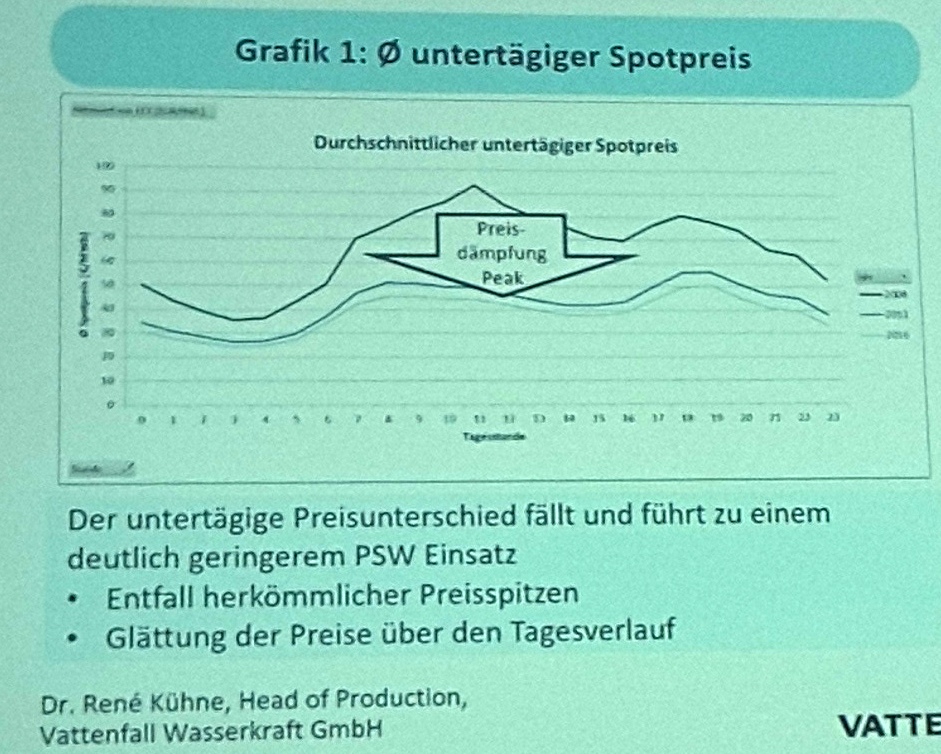
Rene Kühne on the development of the spot price, the peak at noon has disappeared. (Slides)

Today the picture has changed massively. During the day, the high number of photovoltaic systems, with around 40 GB of installed capacity in Germany, makes a significant contribution to the reduction of electricity demand peaks. Although not always, especially in the winter when it is very cloudy and only a few hundred megawatts are generated by photovoltaics. As a result, the price of electricity no longer fluctuates as much as in the past, which is precisely why pumped storage operators have a major problem financing their systems.

It is now the case that even finished plants can hardly generate the revenues to maintain operation. At the meeting in Essen, for example, some spokespersons stated that in the event of a major overhaul, such as the replacement of a turbine, the power plant would actually have to be shut down for economic reasons.

This would, of course, have considerable consequences for the electricity grid, because the pumped storage facilities are also used to stabilize the grid and are supposed to buffer solar and wind power in the future in order to provide the corresponding energy at other times of demand.

A new building is therefore practically unthinkable in Germany, which also meant that the well-known Atdorf project in the southern Black Forest was stopped, although 60 million euros have already been spent on planning.


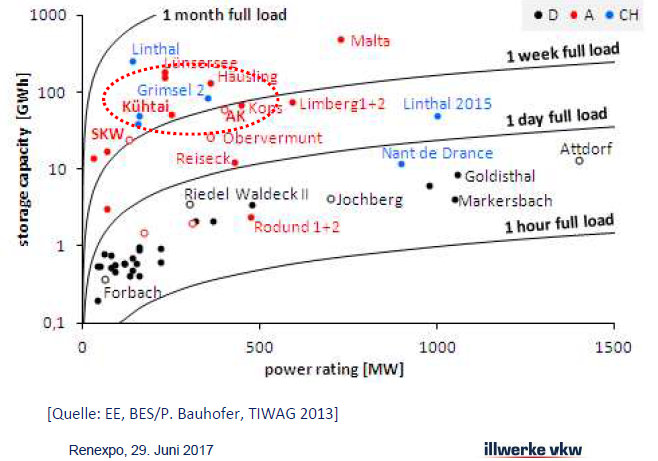
Expansion of the pumped storage power plants has almost come to a standstill, shown as yellow circles, Reinhard Fritzer, ILF (Slides)

Pumpspeicher in ÖsterreichPumped storage in Austria

The situation is different in Austria, where there are considerably more pumped storage power plants, especially in terms of storage capacity. This comes from the large slopes in the Alps around the much larger dams and thus reservoirs.

Professor Helmut Jaberg's famous plant of the Illwerke was presented at the International Pumped Storage Storage Conference in Salzburg. A pumped storage tank with a drop height of more than 800 m and over one gigawatt of power.


The ratio of stored energy to turbine power is larger in Austria and Switzerland, which means that its energy can be stored for longer periods.
Due to the large storage energy capacity, surpluses such as those from longer periods of strong wind can also be absorbed if the lines are sufficient. In times of calm, the energy can then be called off and sold at higher prices.

This is often misleadingly portrayed in the media as if Germany is giving electricity away abroad and reimporting it at great expense. No, there is a service in between that the energy is stored and delivered exactly when we need it!

Storage revenue sources

The very flat price curve for electricity cannot currently finance storage facilities, but there are other sources of revenue for storage facilities, such as balancing the grid. Energy is provided or absorbed at short notice to stabilize the grid.

Control energy is another source of revenue for pumped storage.

In the lecture of the consulting firm BET from Aachen, additional sources of income were presented.

The problem, however, is often the legal regulations, which make it very difficult to treat all markets fairly. This often shows that our energy laws are still too much dominated by the way of thinking in the old energy system. In addition, the transport of energy is not shown, all prices are valid for Germany, although there may be a surplus in Northern Germany and a shortage of electricity in Southern Germany.

The load gradients have been growing in recent years, so fast control power is required.
An alternative to storage is the expansion of the grid, but unfortunately, this is progressing very slowly, so that in the long term a lot of energy coming from wind and sun does not reach the consumer.
Network expansion, only 3% are completed in 2016, Slide Team Consult.

Conclusion

Considering pumped storage alone in a power system does not make sense. In the future, all components of a modern power grid will have to work together. Wind, offshore and onshore, PV, power lines, storage facilities in Germany but also across the border and with fair rules for everyone involved.


Dienstag, 4. April 2017

How much land area does a 100% solar powered world need?

Land demand for solar power

Solar energy for Germany, Europe, and the world

There is a picture in the solar scene (picture 1) that probably almost everyone knows, it shows how large the surface area is when the world is switched to solar energy. It was, as far as I know, published by Mrs. Nadine May for the first time in her diploma thesis at DLR [1]:

Figure 1: Space requirements for solar power plants, according to Nadine May [1]
This image is widely used and should be checked for correctness. First, Algeria is the country that contains the squares for the world and Europe, and Libya, the country which possibly receives the German solar power plants, are no more colonies.

The squares have an edge length of: world 254 km, Europe 110 km and Germany only 45 km.

How big is the energy consumption in the world?

The energy consumption of the world is constantly growing (see figure 2), so it is difficult to specify the energy requirement without a reference year. Currently, the demand is over 30,000 TWh (30,000,000,000,000,000 kWh) using the further processed data from the International Energy Agency (IEA). I have considered transforming factors for certain energy forms (transportation, heating) into electricity.

Figure 2: Global energy demand for electricity, transport and all other forms of demand

This energy should be converted with solar cells (PV) into electricity. There are several factors to consider, the efficiency, the irradiation during a year and the necessary storage of the energy for the night.

Solar cells made of silicon achieve an efficiency of around 20% and are currently the most economical method to generate large amounts of solar energy.

The irradiation is very different in different regions of the earth, in particular, one must always distinguish between direct and global irradiation. For photovoltaics (PV) only the global irradiation plays a role. Therefore, only this radiation is considered.

Figure 3: Global radiation perpendicular to the ground (source: WEC [2])
The map shows that many areas have an annual irradiation capacity of 2000 kWh per year, in particular, the Sahara, but also on other continents good locations can be found; the only exception is Europe.

Necessary Land Area

The necessary areas of the solar cells can now be easily calculated. For the world, we need 30,000,000,000,000,000 kWh per year, since one square meter has an incidence of 2000 kWh which would theoretically be 15,000,000,000 m² or 15,000 km².
Now the efficiency comes into play since only 20% is converted into electricity, we need the fivefold area, that is 75,000 km². However, one has to be able to build the cells and needs paths and additional areas for inverters and storage, which should double the space requirement. This is 150,000 km².
The transport and storage of energy, which is absolutely necessary, since at night the sun doesn't shine, will consume another 25% of the energy, so we are at 200,000 km².

This corresponds to a square of 448 km of edge length, roughly twice as large as in the drawing.

Fair World

Currently, only a few people consume a lot of energy and lots of people have little energy. I am convinced that in the long term all people want at least to reach the standard of living as in Germany. For this, an energy quantity of 15,000 kWh per year and per person would be necessary. There are some countries that already have a much higher energy requirement, but we hope that energy efficiency will also save some energy.

With a world population of 8 billion people, this will yield an annual energy demand of 120,000 TWh or 120,000,000,000,000,000 kWh, or four times the current demand. This would increase the area with solar cells to a square with an edge length of 1000 km (Fig. 4).

Figure 4: Supply the world completely with solar energy in the future
Furthermore, the area of one million square kilometers is still small compared to the Sahara, but a serious part of the solid surface of the earth. The world has about 15 million square kilometers of sunny deserts, which means about 1/15 of this area must be used in the future for solar cells to deliver enough energy.

Storage requirements

If it is assumed that the energy must be stored for at least one day, this requires a storage capacity of 330 TWh (330,000 GWh)
Compared: Germany has pumped storage with a capacity of 0.04 TWh.
If large Gravity Storage systems with 80 GWh capacity (500 m diameter) solves the problem, a considerable number of 4000 pieces would have to be built.

Using batteries from Elon Musk's Gigafactory, the Gigafactory produces at a planned capacity 50 GWh per year; over 6000 years of production or 400 Gigafactories for 15 years are required. This is to provide the capacity for the first time, and we have to continue production because batteries must be replaced after 15 years.

Gigantic conversion

If the global conversion to solar energy succeeds, huge buildings in the form of gigantic solar fields will be necessary. Surely the roof surfaces are never enough. Furthermore, investments are in the order of magnitude of the global gross social product of one year ($80,000 billion). This sounds a lot, but it will help mankind to be sustainable. Especially when one considers that afterward energy is produced clean, without CO2 and at a low cost.

I think: we can do it!


Sources:

[1] Eco-balance of a Solar ElectricityTransmission from North Africa to Europe, Diploma Thesis of Nadine May, Braunschweig, May 2005

[2] World Energy Resources Solar 2016, World Energy Council 2017

A 186 page paper going into details is from Jakobson et.al., 100% Clean and Renewable Wind, Water, and Sunlight (WWS) AllSector Energy Roadmaps for 139 Countries of the World

Montag, 24. Oktober 2016

Global Demand for Energy Storage

Energy Storage Demand in a Sustainable World

The global transition to renewable energy production is in progress. Last year, 2015, more renewable power capacity, like solar and wind power, was installed as conventional capacity like coal and nuclear. Besides this nice development, there is a weak spot, the installed solar and wind capacity produce only when the sun is shining or the wind is blowing. For a full change to an emission-free world, we need energy storage.

How big is the storage demand on a global scale, this is hard to guess, because it depends on a lot of assumptions. I will try to make a good guess within this post.

The Global "Energiewende" 

I will not describe the "Energiewende" (change of the energy system) in Germany, I will focus on the global change. This makes sense because we have to change the energy system on the global scale to stop the carbon problem and limit the exhaustion of the scare fossil fuels. 

The strong growth of PV installations, about 70 GW are expected for 2016, continues the long-term trend of constant fast growing installations over the last decades. 

This trend will change the energy system as we know it today within two decades, to understand these let's look into the near history.

The growth of the energy consumption and the installed renewable energy production.
Consider the logarithmic axis of the installed power. Data source BP 
The first thing is, the electric power demand has a constant annual global growth of 3%. The installation of wind and solar power combined grows every year with 22%. The result will be, that somewhere around 2025, more fluctuating renewable energy is installed as conventional power plants. 

But be careful, the produced energy of wind and sun will still not match the demand, because they only produce energy when sunlight or wind is available. Resulting in the green line, which represents the mean renewable power generation. This line hits around 2030 the demand.

The result is, the next century will be dominated by the installation of storage to match the fluctuating production at any time with the global demand.

Influence to the Storage Demand

The main impact for the storage demand has the electric grid infrastructure. The reason is, that the grid is the most efficient way to transport the electric power from the source to the customer. Is the sun shining in the southern part of a country, it is efficient to bring the energy to the cloudy northern part. And similar, if the northern part has a lot of wind during the night it makes sense to bring the energy with the same grid to the customers in the southern part.

This results in a competition between grid and storage.

To find the economic optimum between power grid size and storage is complex
Theoretical, it would be possible, to span a global grid around the globe and connect this grid with all solar power plants. This would result in a perfect 24-hour solar power supply without any energy storage at all because the sun shines always at some places on our earth.

The main problem seems the high price of such a grid and the energy loss in the power line. The other extreme case is a power storage at home with a seasonal capacity (only necessary in the northern region) of 1000 kWh for every person in the house. Then we can go off grid, sufficient PV on the rooftop assumed. The price for the batteries may reach a million dollars, not affordable.

If we dive into detailed computer simulations as done by J. Tambke und L. Bremen [1] we learn, that a country like Germany needs a storage capacity of seven days after a complete conversion to wind and solar has happened and there is a perfect power grid, often called a copper plate. 

Expanding the area of the perfect grid connection to an area like Europe only two days of storage is necessary. If we are optimistic and assume a perfect grid of this semi continental scale we need only a storage capacity of two days.

Further Chances to Optimize

Besides the grid, another chance to minimize the storage demand is the so-called smart grid. Whenever possible, an energy consuming element in the grid goes offline if the power price is high or goes online if the price is low.

We don't know the exact possible amount of energy demand that can be shifted to other times but an optimistic guess might be, that 50% of the demand can be shifted in a way that the storage demand is halved.

Assuming this, we need only one day of storage if a smart grid and a continent-size grid is available.

Adding up the Numbers

The energy consumption in the world in the year 2030 will be around 4,000 GW. To store this energy over one day, we need a 24h storage system with a capacity of 96,000 GWh. Keep in mind, the Gigafactory of Elon Musk may produce 100 GWh per year. If all the storage is used for the global Energiewende, the production for this demand needs about 1000 years.

But be careful, other solutions may be available.  The energy stored in the lakes of Norway contains an astonishing amount of 80,000 GWh, although there is no pump, the stored volume can only be used once in a year and has to be refilled by natural perception.
Pumped hydro technology may be a good solution, especially the Gravity Storage system, a typical site can store about 8 GWh. We still need 10,000 Sites, but this seems to be more within practical reach, than a bure battery solution.  


References


Montag, 17. Oktober 2016

World Energy Council Meeting 2016

World Energy Congress 2016 in Istanbul


From 9th-13th October 2016, the World Congress on Energy was held in Istanbul. It was the 23rd Congress since 1923.

The topics of the congress were distributed over the entire energy area, including the oil and gas production and renewable energies. There were many important statesmen like Russian President Vladimir Putin and the Turkish President Recep Erdogan, including many other government members from different countries, including the visit of Israeli Energy Minister Yuval Steinitz, the first official meeting after six years frozen relations between Turkey and Israel.
Side by side, Putin and Erdogan at the conference in Istanbul

Vladimir Putin talk was about the importance of energy and the price of oil, a remark about a co-operation with OPEC during the speech has moved the oil price to rise by 2 $! He was the only statesmen, who included the words "exponential growth of solar energy".

The issue of energy just brings together not only scientists and engineers but also politicians and diplomats. The global linking of energy distribution, especially natural gas, plays an important role and Turkey was presented as a hub between Asia, Middle East and Europe and the Mediterranean.

The world's energy

All participants have concluded, that the energy transition towards renewable energy, particularly solar and wind, is on the way. However, the completeness and how fast that arrives is controversial. While I am convinced that before the end of the next decade the significant change of the energy system has been completed, Marie-José Nadeau, Chair, World Energy Council believes that in 2060 the share of renewable might reach only 50% of total energy production [1],
Marie-José Nadeau, Chair, World Energy Council

This is understandable from the perspective of the energy industry. They trade with oil, coal and natural gas. Should the change take place quickly, the oil and the coal is not any longer requested by the market. The industry worries about stranded resources. This means the oil in the ground, on which the wealth of large companies and nations is based, may become worthless.

Key issues in the energy transition in the coming decades

The importance of the Paris Convention for the CO2 reduction was repeatedly stressed. Generally, however, many see only a shift from coal to natural gas, as is well known, natural gas produces half as much CO2 when it is converted into electricity than coal! This is due to a fact that a methane molecule consists of one carbon and four hydrogen atoms, but also to the better efficiency of gas power plants.
Key finding: the phenomenal rise of solar and wind energy will continue!

Power Turntable Turkey

At the conference in Turkey, the geo- (energy-) strategic role of  Turkey was stressed by Erdogan.

Important oil and gas pipelines connect large resources of Asia with European customers, more gas and oil pipelines are planned.
The strategic position of Turkey

Finally, the construction of a new gas pipeline connecting Russian and other Asian gas fields to Europe by crossing Turkey was one reason why Putin, but also the President of Azerbaijan, Ilham Aliyev, showed up in Istanbul.

The Importance of Hydro-Power

It's a certain irony, the most important renewable energy in the global mix, providing at least 71% of all renewable energy is hydropower or 6.8% of global electric energy production, is an often forgotten big player.

The importance of hydropower may lie in a combination of solar, wind and hydro-power. At the conference solar power, as named a water saver, in the form that during the day the turbines are shut down at the dam resulting in increasing water level, during the night, with redoubled turbines, water can be used for power generation. Thus normal dams are important energy storage elements for the energy transition. ot to forget pumped hydro storage or even the new technique of Gravity Storage .
A nice photoshop picture used as advertising billboard in Istanbul

There are, at least in Africa and in South America, still many untapped hydropower "reserves". However, anyone was well aware that each dam has also an enormous impact on nature and very often engages in the habitats of people! Especially in India, the water of the rivers is sacred and thus hardly the construction of dams possible as mentioned by Richard M. Taylorlearned Chief Executive, International Hydropower Association.

Africa to get electricity

While the inhabitants of the Americas and Asia are almost completely supplied with power, in Africa there are still 600 million people without electricity. This means no light, no easy way to charge a mobile phone, no fridge and no welder.

The last day of the conference was therefore devoted to Africa. In Africa, here essentially black sub-Saharan Africa was meant, you have to think about the huge areas and the still sparsely populated countries. This makes the construction of a conventional electric grid network uneconomical and therefore solar energy stand-alone systems and microgrids are very important.
The forum "Talent and Capacity Building" moderated by Samir Ibrahim from Kenya, right Sanjit 'Bunker' Roy from India, next to Andreas Spiess, Solar Kiosk , from Germany.

The practical implementation requires some knowledge of electricity and solar energy. Bunker Roy helps the people with his Barefoot College to teach this to everyone. While he teaches women worldwide (Grandmothers) to practical issues of the use of solar energy, an impressive project!

Andreas Spiess tries with his, as he stressed, a commercial solution of the solarkiosk promoting the dissemination of locally adapted use of solar energy in Africa.

The Exibition

There was a international exhibition were companies and countries presented interesting ideas and investment opportunities.
Booth of Heindl Energy GmbH

The Heindl Energy GmbH has presented the "Gravity Storage" technology on its exhibition stand. Unfortunately, very few companies from Europe were represented at the fair. The booth was right next Aramco, the largest oil company in the world from Saudi Arabia. As far as I have observed, our stand had awakened almost more interest.

A 600 MW power plant on the water for emergency cases

There were of course many other interesting exhibition stands, I found the idea of "power ship" interesting, which is a ship with a complete power plant (up to 600MW), inclusive substation, which anchors in a port and supports the local power generation, after a natural disaster or for other reasons.

Reference:

Montag, 30. Mai 2016

Serious Problem: Battery and Automotive Industry

Lithium-Ion drives the Future

The basic innovation LiIon battery, driven by the company Sony, has surprising, but that is common in innovation, enabled the development of electric cars. 

Previously there were only ugly batteries, some were extremely heavy, lead-acid battery, extremely toxic, nickel cadmium, or other drawbacks why they were not suitable for an energy storage device in a car. This has seduced the automotive industry to believe everything would stay the same and no special attention was given to the development of batteries. 

With the successful development of the Tesla S, an all-electric car, everything has changed fundamentally, so I will report here about the importance of battery technology in the automotive industry.

The value Chain in the Car Industry (today)

Four things make the value of a car:
  1. the glider, a vehicle without powertrain and energy storage
  2. the engine with storage (tank or battery)
  3. the image of the brand (mostly through advertising)
  4. the amount of energy consumed by the car in his life
The glider is now a product of the OEM, headlights, bumper, seats or wheels and tires, almost everything visible to the driver is not produced in the car factory. Only the steel welding of the body remains in most car factories, with high automation done by robots.

The engine remains us to the 19th century. An internal combustion engine with a mean efficiency of about 20 percent, emitting significant amounts of particulate matter and other unhealthy substances, accelerates the car more or less rapidly to cruising speed and keeps on this pace. Thousands of engineers try to optimize this technology with legal or illegal means.

The image of cars of different brands developed by massive advertising budgets [1]. Through product placement in movies and elaborate sales centers, a high value of the car is suggested, although all the cars stuck in traffic driving at the same speed. For many people, the car is next to the house, the most expensive product that is purchased for own appreciation.

The fuel that a car burns during its operational phase of approximately 200,000 miles (ca. 321,869 km), may sum up to $30,000 (depending on local tax) and is often more expensive as the whole car. In addition, no one knows during car purchase how the gas price will develop. The money ends up in the pockets of the oil companies and oil states, not in the automotive industry!

Summarized, the major carmakers only can manufacture engines, the rest of the value chain is lost.

The electric car value chain

Electric cars have a significantly different distribution to the above points 1 to 4

The glider remains essentially the same, interestingly, the weight saving is less important than with previous cars because by recuperation (recovery of braking energy). The energy to accelerate and the energy to go uphill is not used for heating the brake disk, as in conventional cars.

The use of non-rusting aluminum is useful because the life of an electric motor is considerably higher than that of an internal combustion engine. And who wants a rusty electric car that still has a good engine and a working battery.

The value of the electric motor is far below of an internal combustion engine, which consists of 6000 moving precision parts. Electric motors are simple, some copper wire winding and an aluminum cylinder which rotates. Rare earth elements are not necessary, which can only be found in hybrid cars like the Toyota Prius (46 kg!).

There is no fuel in the electric car. But we need a battery and electric power to drive the car. The batteries are by far the most expensive part in an electric car and remarkably similar in price compared to the fuel costs of a conventional car.

Amazingly, this was not noticed neither by the big oil companies nor the major car companies. Exception: Tesla builds a Gigafactory, a battery factory which can supply batteries for about 500,000 electric cars a year, thus making the company independent from other suppliers.

Only the German company Volkswagen has announced that it is considering $ 11.000.000.000 to invest in the construction of a battery company (GAS2) Unfortunately, I have heard such announcements in the area of e-mobility by automotive companies several times. Actual, so far nothing was created.

The "fuel" power would actually be a clear claim for the utilities or oil companies. Here there is complete silence.

The problem of everyday usefulness

If you want to use an electric car just like your previous car, it must be reliable cover about 60 miles a day, but it has also to master the holiday trip or extended business trips.

For daily demand, the socket in the garage is sufficient for overnight charging. resulting in a very limited contact to a gas station. Except perhaps refill the windshield wiper fluid and visit the car wash.

On longer trips, every car must refuel new energy. At the gas station, this is done within five minutes. To charge an electric car during the trip should not substantially extend the duration of the trip. So it is imperative that there is a network of fast-charging stations. 

At this point, I'm amazed to read that the policy in Germany will subsidize 10,000 charging stations (per charging station $ 70.000 tax money). However, they do not demand the fast charging ability.

Only charging stations, where you can charge more than 200 miles range in 30 minutes (supercharger) lead to everyday practicality of electric cars.
No other company than Tesla operates or plans to operate a supercharger network. A network that could be owned by an automaker or other organization. I think oil companies, motorway service areas or  power companies, should be interested to roll out a fast charging network,
Ending up in a monopoly situation, anyone who is interested in an everyday useful car can now only buy a car from Tesla, all other manufacturers have virtually no usable electric car on offer.

The fairytale "battery problem"

The common theme in the discussion about electric cars is the battery problem. It involves at least three subjects
  1. battery price
  2. lifespan
  3. raw materials
Prices of batteries are in free fall. On the picture, you can see a slide that has been shown on the Menasol 2016 Energy Conference in Dubai. Compared to the drop in solar cell price, the price of LiIon batteries appears to move even more quickly down.
Development of battery prices, when the market doubles the volume, the price drops by 26%

If the price of batteries is at $250 per kWh and a car needs for the daily use about 80 kWh, the battery will cost $20,000. Counting the cost of electricity results in less than the fuel costs of a conventional car.

The service life for batteries depends on the charging cycles, and some other factors, such as temperature decreases. A Thousand charging cycles required can be delivered by virtually all the batteries, even a lead battery. But this means 200,000 miles (1,000 times 200 miles per charge) is easily reachable by a battery and beyond the lifespan of the vehicles. Moreover, it seems to be that although there is a slight decrease in capacity, a second life of the battery is possible. For example, to use the battery in a PV system for overnight storage.

The raw material lithium (60ppm [2]) is much more common than lead (18 ppm in the earth's crust [3]) to be found. Thus, there is no problem of raw materials, even if it could lead to bottlenecks due to slow expansion of mining activity. Unlike oil, lithium is not consumed in the car but can be 100% reused. Lithium is also non-toxic, who spices his soup with sea salt, is eating lithium salt, which in large quantities is part of the sea(salt).

Old industry fails in innovation

Although the facts about electric cars are easy to understand, you wonder why the auto industry is doing almost nothing. The problem is more than a century of grown structures. Virtually all automakers are over 100 years old, except for Volkswagen, a company which was established on 28 May 1937 by Hitler.
In these companies, there is extremely much knowledge about internal combustion engines. Ignition and oxygen supply, exhaust and catalyst are investigated by expensive and complex means. The technological elite in the automotive industry understands the combustion engine, studied and graduated on that topic.

Battery technology, lithium-ion, and electrolytes they have heard about in the media. It is not their core competency. How to go about developing the technology? The natural reaction is waiting and building seven-speed transmission and hybrid engines or even worse hydrogen engines.

Simultaneously a startup, Tesla Motors, succeeded to be about five years ahead of the pack. Installed thousands of supercharger stations and without expensive advertising build a brand image that fits a clean environment with renewable energy.

It would not be new in the history of innovation that industry does not survive the change in technology. No sailing Shipyard has built steamboats, short before bankruptcy they tried with seven master sail and "hybrid" (Sail plus steam engine).
No mail order retailer could defeat Amazon or eBay.
No telephone company, Siemens, Motorola nor Nokia, plays an important role in the smartphone league.

We will have to accept that some companies like VW / BMW / Daimler are in ten years only a brand name but no longer large employers. 
Peter Schumpeter described this with the words
 "Creative destruction"
And he probably has once again right.

(I tried hard to translate this from my first German blog article "Lithium Ionen treiben die Zukunft an", should you find any flaws, tell me)

Further comments:

[1] Volkswagen spent more than $110 million in Germany for advertising in the months January till  April 2016, source: Nielsen / Statista.
[2] ppm stands for "parts per million", which means you take a ton of average rock, then 60 grams of lithium and 18 grams of lead are contained therein.
[3] The mass fraction concealed, that a kg of lead can only store about a factor of 50 less energy than a kg of lithium. Viewed from this condition, you need less lithium for all cars (if they are electric) than lead is used today for starter batteries in petrol and diesel cars. 

Samstag, 16. Mai 2015

Is 100% Photovoltaic possible?

The World powered by the Sun

Today, photovoltaic electricity is only a small fraction of the global electricity production. The volume seems to be one percent in the year 2015. If we do a very simple extrapolation and imagine, that all these PV modules were installed in 2014 and we continue this installation speed, then we need another 99 years, to have a 100% emission free PV world. But this is simply not the way the world goes round.
I will try to extrapolate the situation, based on data from the MIT report "The Future of Solar Energy" [1]

Analyse the past of Photovoltaic

If we wont to understand the future, it is very useful, to look into the past, not only to understand the development but also to understand the error which occurred by predicting the future. 
The Energy Information Administration (EIA) and the International Energy Agency (IEA) predict since 10 years the global PV installations in a published outlook. The first outlook from 2006 predicted for the year 2030 a global installation of 100 GW. This volume was already matched in the year 2011, only five years after the report was published! Ok, one wrong shot can be excused.
In the year 2011, the EIA predicted 150 GW until 2020. Again a failure, already in 2014 we have reached 180 GW of solar. 
The MIT analyzed all predictions and compiled them to a very nice picture:
Figure 1: Different predictions and the reality, source MIT [1] page 137
In the early time, the predictions of the IEA had an exponential growth, that is a good guess, because most of the time, new products grow in that type. The only problem was at that time, the growth factor was too small, for example, see IEA 2008 prediction in figure 1. Today things have gone worse with the prediction from the IEA. Not only is the factor to small, the prediction includes a reduction of the production of PV itself. This seems hard to understand. (An in-depth analysis was done by Christian Breyer, paper PDF)
Things got even more strange when we look at the price predictions of PV. The EIA predicted the development of the PV price till the year 2030. It should be mentioned, that it is a very difficult task to predict a price of any product for more than 20 years. But this failure is very illuminating.
Figure 2: Price prediction by EIA IEO 2009 of PV and observed results. [1] page 137
The EIA IEO 2009 outlook predicted, that the capital cost of PV in the year 2030 will drop to 4$/W.
Actually, the price even for residential systems dropped to this value already in the year 2014. It should be noted, that the price for residential PV systems in Germany was at the same time at 2$/W.
The price for utility PV systems reached only two years after the report was published the predicted value for 2030, 4$/W. 
All this information should be available to the EIA today. It irritates me, why the EIA does not change the prediction about the deployment of PV although they can observe the rapid price drop obviously. (I am thankful for any helpful hint)

Is there enough material for a large rollout of PV 

One possible reason, to be pessimistic about the global rollout of PV might be the scare elements used in PV systems. Today almost all PV systems use Silicon to convert sunlight into electricity. The MIT analyzed the production of different raw materials, essential for the production of SI-PV-modules. 
To set up a PV system we need concrete and steel to mount the panel in the direction of the sun. Glass, aluminum and plastic are necessary to protect the silicon cell, copper and more plastic are necessary to transport the power away.
Figure 3: Commodity materials required for PV. [1] page 131
Today, all these commodities are produced in a volume, that no real bottleneck will occur. In figure 3, we can see, that the steel production of 9 days is sufficient, to mount all PV panels for 5% of the global electricity production, within half a year, the steel production is sufficient for a 100% conversion to PV.
The least available material in this consideration is glass. For a 100% PV world, we need the glass production of 20 years. But glass production is in no way a limiting factor. The necessary raw material is sand, an endless resource.
The solar cell itself consists of a silicon wafer and some silver, are they rare?
Figure 4: The annual production and requirement for a solar future. [1] page 135
In figure 4 we see, that silver might get a little problem because we need an amount of silver that is produced within 30 years. It should be mentioned that new technologies of production can reduce the necessary mass of silver very strong. Other elements, like Ga, are only necessary if we would use GsAs cells in our PV systems what is not widely the case. 
We conclude the raw material is no show stopper for a PV future.

My prediction of PV growth

Compiling all this information, I come to a quite different prediction than the IEA. My simple, but till today best guess is, that the exponential growth will continue, but at a lower rate. 
Figure 5: Long-term trend of PV installation.
In figure 5 we see the global installation of PV shown as a black curve in this logarithmic plot. In the year 1992, we had only 100 MW of PV installed, ten years later, in 2002 it was 1000 MW, Today it is about 200 000 MW!
Update to Figure 5 including the growing power demand, wind, and the latest figures available 2016.
If the growth rate continues at 25%, as seen within the last three years, we will reach 100% PV not long after the year 2030. Remember, today we have a global power plant pool of 5300 000 MW, sufficient to power half the world. Even if we expect, that the future is fair to all people, we need "only" 10 000 000 MW to bring electricity in every home on this planet, long before 2050.  

One problem remains: Storage

Without an affordable storage system, PV can only bring electricity during sunny daytime. For a complete conversion, we need about 90 000 GWh of storage [2].
One solution for residential systems may be the power wall from Tesla, but I am not convinced, that this makes sense on a large scale. For large scale, I recommend the Gravity Storage!

References:

[1] The Future of Solar Energy, 2015 Massachusetts Institute of Technology, ISBN (978-0-928008-9-8)
[2] Elon Musk predicts (minute 18) during the presentation of the power wall 90 000 GWh of required storage. https://youtu.be/yKORsrlN-2k

Samstag, 28. Februar 2015

PV Price in the Future

Massive Price Drop in PV Systems

The future will be solar if the price of photostatic (PV) systems drops. There is a new research result about the future of the PV price online, done by Fraunhofer ISE [1], that gives surprising insights. I will discuss the results in this blog post.

Learning from experience

The first silicon PV cell date back to 1950s and since the 1980s there is a global market and production worth mentioning. Since then, the price of PV cells was constantly dropping. The interesting thing is, there is a mathematical law, that describes this drop. To keep it short, this law tells us, that every time, the production of PV doubled, the price fell about 20%. 

The actual development is shown in the graphic:

Development of PV module price since 1980 [1]

To understand this plot, be aware, the right axis is the accumulated produced capacity of PW measured in GW. It starts with 0.001 GW (=1 MW) and ends with 100.000 GW. To cover this vast range, the scale is logarithmic. The first price tag dates back to 1980, where we had to pay more than €20 per watt. The price is adjusted for inflation to the level of 2014, an exchange rate of one Euro gives $1.25 is in use. The last price tag is for 2014 and is in the range of €0.5 to €0.7 for large-scale PV power plants. 

Learning Curve

It is not surprising, that the actual price in different years is not always precise on the long-term trend curve, that shows a drop of 20,9% per year, due to market effects. 

The big question is, how will this learning curve develop in the future? There are three scenarios, a very conservative one, that tells us, only 19% drop with another doubling of the installed PV base, a medium scenario with 20.9% drop and a progressive one with 23%. However, the result will always be a sharp drop of the PV panel price, if the installed base grows in the future. 

Below a price of €0.2/W, there seems to be another limitation of the pure raw material cost. To me´, this limitation seems a little artificial, because of the price of this raw materials, like silicon or glass, could also drop if the production volume grows far beyond today's volume. 

It should be mentioned, that a capacity of 100.000 GW PV installation is equivalent to a surface of one million square kilometers, this is the size of a country like Egypt or Texas and California combined!

How expensive is electricity in the future?

The price of a PV panel is not the only part of the cost drivers in solar power. To break the price down to a kWh of electricity at the grid feed in, we have to include other cost drivers. 

Price of different elements for real-world PV grid-scale sites. [1]

The first surprising thing is, that the PV-modules are no longer the main cost driver, as shown in the figure above. The cost of mounting, connecting and planning top already this cost. The paper from ISE does not cover "Red tape", this will hopefully drop in the future, but nobody knows.

Another significant part of the cost drivers are the inverter, they produce AC from the DC, generated by the PV cell. The price of this inverter follows a similar law of price drop by market volume as the PV panels.

Price per kWh

To calculate the price of a kWh of electricity itself, we have to take the solar radiation and the capital cost into account. There is a calculation method, the levelized cost of electricity (LCOE). It includes capital cost and maintenance of the PV power site. If you are a geek, you can do the math with the following formula:

Calculation of the levelized cost of electricity (LCOE). [1]

The interesting result is, that one of the main factors for electricity from PV is not only the sun but the interest or discount rate. Today, we live in a world with very different interest rates. A strange effect is, if we look at the globe, the countries with high insulation have often very high-interest rates. For example, Germany has a low insulation but also a low-interest rate, Spain has a relative high insulation but a significantly higher interest rate. The result is, the price of PV energy is much more similar as we first guess.


PV power price depends on the cost of capital. [1]

Long-term development

To look into the future beyond 2020 is very difficult, but the gathered information gives us some hints. The first thing is, PV electricity price will drop due to the learning effect resulting from the growing market. The market is growing because PV electricity gets cheaper and is competitive with all other electric power sources. The long-term price in the scenario of ISE is in the range of  2 ct/kWh. 
The share of the market will be beyond 30% in 2050. 

But there is an obstacle on the path to solar. The sun shines only at daytime and only if there are no clouds. This results in a strong request for energy storage. One solution is the new concept of Hydraulic Rock Storage (HRS) as developed by the Heindl Energy in Germany. 

Energy storage using the Hydraulic Rock Storage. [2]

Combining a cheap storage with a storage price of 3 ct/kWh and PV in the range of 2 ct/kWh gives a long-term price for electricity over the whole day, only a fraction is stored, for less than 5 ct/kWh in most regions of the world.

Reference:


[1] Fraunhofer ISE (2015): Current and Future Cost of Photovoltaics. Long-term Scenarios for Market Development, System Prices and LCOE of Utility-Scale PV Systems. Study on behalf of Agora Energiewende. http://www.agora-energiewende.org/service/publications/
[2] Heindl Energy, Hydraulic Rock Storage, http://heindl-energy.com/ 

Donnerstag, 19. Juli 2012

Storage Maters


Fuel is Stored Solar Energy

We live in a world, where the energy we consume was stored eons ago by nature. The conversion efficiency of solar energy into oil was really lousy, only a fraction of the solar radiation was converted to biological mater, only a fraction was laid down into the ground and only a fraction is now available. If we do the math, we find, that less than one billionth (10E-9) of the solar energy, which reached the earth within the last 100 million years, is stored in our fuel resources. This leads to the idea that we can do better than nature! Using solar radiation energy conversion systems like photovoltaic or concentrated solar power, we end up near 20% conversion rate, which is sufficient for economic land use and by a factor of 100 better than plants, who only convert 0.1% of the energy in usable fibers or sugar. It should be mentioned, plants need water and solar cells love deserts! Resulting in no competition of land use if we are smart and don’t plant for energy but plant for food.

The Storage Problem Remains

There remains a problem, storage! Storage was never an easy business, but if solved it changed the world. Inventing hey, for example, was necessary to conquer the northern hemisphere, where in wintertime is no food for the livestock. Storing information in books was the breakthrough for the industrial age and unlimited computer storage capacity is essential for our information age.   

The upcoming renewable power age lacks efficient and cheap storage capacity for electricity. Knowing this, we could visit the known technologies and there potential to solve the problem if further developed. Best known to the public are batteries. This is, by the way, a big problem, because our politicians, driven by their simple mind and the public, believe in batteries. Batteries are fine for mobile applications like cell phone and laptop. Cars using batteries are still expensive, but it may be within the reach of our technology to power them by batteries. Things get much more difficult if we want to use batteries for grid-scale applications.

Batteries are expensive and need some more or less rare and expensive metals, they use processes which are not perfect rechargeable, this is the reason that batteries run out of business after a few thousand charging cycles. All this does not matter, if we use a mobile phone, live time is limited, the price of the battery is not the main value of the device and we don’t care to much on the environmental impact on the small scale that is involved.

Grid-Scale Storage is Different

If we need storage for large scale, and grid technology is always about GW and TWh, values, which are trillion (10E12) times above the mobile phone and laptop scale. This is, by the way, easy to guess, as long as billions of consumers are out there. There are three different questions, how expensive is the storage capacity, how many times can we recharge it, and how efficient is the process. The reason why price matters is we can only earn a limited amount of money on every charging cycle. If the battery life is already finished, before we have earned enough money to pay for the battery itself, it is useless to buy the battery at all.  The situation for the efficiency is in some way similar. If we have to pay more for the energy to charge the battery as we earn during discharge, the system doesn´t work either. The problem of efficiency is not the core problem of batteries, but of many other storage concepts. Batteries suffer from the price per storage capacity. 

Why Batteries don´t Work

Price of storage capacity for many batteries is above 200$/kWh, even for the very simple and widely used lead-acid battery. Lithium-based systems are often above 1000$/kWh although prices were dropping during the last two decades. Let´s do a simple calculation; our battery should be charged every day, as it makes sense in solar power systems. During nighttime, the price of power should be 10ct/kWh more expensive as at daytime. If we discharge the battery, we earn 10ct every day and within six years we have a return on our investment into the lead-acid battery. But this does not hold due to the fact, that our battery dies after about 1000 cycles. Using the Lithium system, things are even worse, we have to wait about 30 years for the return of our invest without any interest rate, this does not attract many investors.

More Storage Technologies

We visit other techniques of storage in the next blog posts

  • Methane
  • Pumped Hydro
  • Hydraulic Hydro Storage


Dienstag, 10. Juli 2012

The Energy Age

Within human history, we have seen four times, where the primary energy source changed.
The first and most significant moment in energy history was the control of fire. It gave us something, no animal ever had, heat and light, independent of the environment. But as burning wood was the widespread source of energy, it got rare and too expensive for burning anywhere.
The second change was the move to coal, including the development of the steam power engines. It gave us independence from the location for mechanical work. Before the steam power age, at some places, water power had some impact on production. Burning coal is cheap, but coal is finite and the carbon dioxide emission seems to be a serious threat to the climate.
The third change was oil. Combined with the ford car, it gave us mobility on land, and a bit later, in the air. The 20th century was the golden age of stored energy in mineral oil. After peak oil at the beginning of the 21st century, it is not a good idea, to rely on this energy source forever.
The fourth change never made it to the top level, it is the nuclear power, a very strong power source, but also a very dangerous fire. It started with the atom bomb and was controlled to some level in nuclear power plants.  Due to human frailties resulting in design and operation errors of facilities, some power plants failed disastrously.
With the upcoming of the silicon age for semiconductors, a small niche appeared for the use of silicon. Solar cells on satellites for energy supply. Invisible small amounts of energy were generated in the 70´s, first attempts for commercial use started in the 80´s, continuous growth began in the 90´s and as a trend, every 18 months since then, the global photovoltaic installation doubled. This is called an exponential growth. You see just nothing at the beginning, and after some time astonishing things happen.
This fifth energy source is different to the accustomed energy sources we have seen in history, it does not contain an inherent storage system, so we have to care about energy storage!
Concluding this, my thesis is:
  1. Within the next 20 years, photovoltaic will be the primary energy source of the globe
  2. Energy storage will be the most critical point of this change
Keeping this in mind, my blog will tell you the story of this fascinating change in human energy generation. You have the chance, to watch live the biggest and last change in energy supply of mankind!