I discuss different ideas concerning the global change in the energy world.
I highlight the global change to renewable energy concerning solar and wind and the demand for storage. Sometimes I visit conferences and will report on the results.
The demand for pumped storage facilities in central Europe
IIn the year 2017 I was at two pump storage plant meetings,"Pumpspeicherwerke" in Essen on July 10,2017 and on November 29/30 at the 3rd International Pump Storage Conference in Salzburg, the results are somewhat contradictory and I want to discuss them in this blog post.
(This article about pumped storage was first posted in German language and was translated with the help of deepl.com)
International distribution of pumped storage power plants.
Pumped storage in Germany
The German pumped storage facilities have a capacity of 40 gigawatt-hours and a connected load of 6 GB, these are enormous figures but in relation to the electricity system they are rather small, the power capacity is about one-tenth of the German electricity consumption and the energy capacity could supply Germany with electricity for less than an hour (if the power capacity were sufficient).
The task of the pumped storage plants in their original function, however, was not to supply Germany with electricity overnight if the sun doesn't shine, but to manage failures of nuclear power plants or to cover peak loads during the lunchtime period, which were caused by switching on many electric cookers in earlier days.
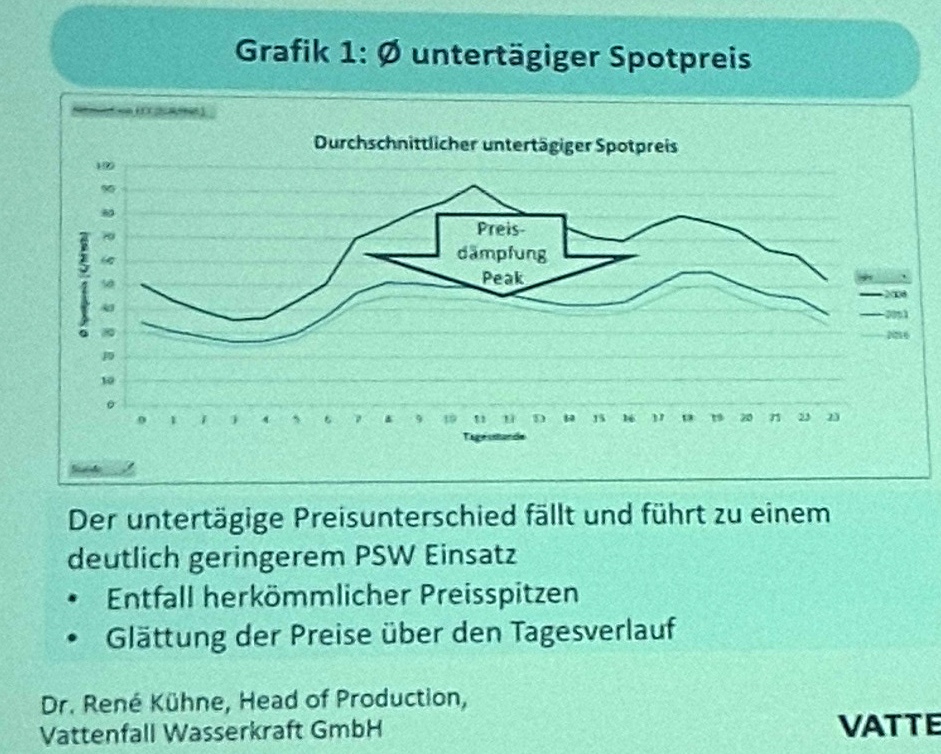
Rene Kühne on the development of the spot price, the peak at noon has disappeared. (Slides)
Today the picture has changed massively. During the day, the high number of photovoltaic systems, with around 40 GB of installed capacity in Germany, makes a significant contribution to the reduction of electricity demand peaks. Although not always, especially in the winter when it is very cloudy and only a few hundred megawatts are generated by photovoltaics. As a result, the price of electricity no longer fluctuates as much as in the past, which is precisely why pumped storage operators have a major problem financing their systems.
It is now the case that even finished plants can hardly generate the revenues to maintain operation. At the meeting in Essen, for example, some spokespersons stated that in the event of a major overhaul, such as the replacement of a turbine, the power plant would actually have to be shut down for economic reasons.
This would, of course, have considerable consequences for the electricity grid, because the pumped storage facilities are also used to stabilize the grid and are supposed to buffer solar and wind power in the future in order to provide the corresponding energy at other times of demand.
A new building is therefore practically unthinkable in Germany, which also meant that the well-known Atdorf project in the southern Black Forest was stopped, although 60 million euros have already been spent on planning.
Expansion of the pumped storage power plants has almost come to a standstill, shown as yellow circles, Reinhard Fritzer, ILF (Slides)
Pumpspeicher in ÖsterreichPumped storage in Austria
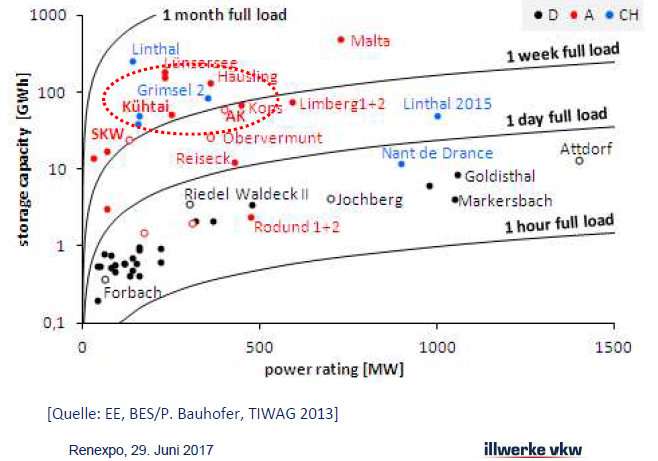
The situation is different in Austria, where there are considerably more pumped storage power plants, especially in terms of storage capacity. This comes from the large slopes in the Alps around the much larger dams and thus reservoirs.
Professor Helmut Jaberg's famous plant of the Illwerke was presented at the International Pumped Storage Storage Conference in Salzburg. A pumped storage tank with a drop height of more than 800 m and over one gigawatt of power.
The ratio of stored energy to turbine power is larger in Austria and Switzerland, which means that its energy can be stored for longer periods.
Due to the large storage energy capacity, surpluses such as those from longer periods of strong wind can also be absorbed if the lines are sufficient. In times of calm, the energy can then be called off and sold at higher prices.
This is often misleadingly portrayed in the media as if Germany is giving electricity away abroad and reimporting it at great expense. No, there is a service in between that the energy is stored and delivered exactly when we need it!
Storage revenue sources
The very flat price curve for electricity cannot currently finance storage facilities, but there are other sources of revenue for storage facilities, such as balancing the grid. Energy is provided or absorbed at short notice to stabilize the grid.
Control energy is another source of revenue for pumped storage.
In the lecture of the consulting firm BET from Aachen, additional sources of income were presented.
The problem, however, is often the legal regulations, which make it very difficult to treat all markets fairly. This often shows that our energy laws are still too much dominated by the way of thinking in the old energy system. In addition, the transport of energy is not shown, all prices are valid for Germany, although there may be a surplus in Northern Germany and a shortage of electricity in Southern Germany.
The load gradients have been growing in recent years, so fast control power is required.
An alternative to storage is the expansion of the grid, but unfortunately, this is progressing very slowly, so that in the long term a lot of energy coming from wind and sun does not reach the consumer.
Network expansion, only 3% are completed in 2016, Slide Team Consult.
Conclusion
Considering pumped storage alone in a power system does not make sense. In the future, all components of a modern power grid will have to work together. Wind, offshore and onshore, PV, power lines, storage facilities in Germany but also across the border and with fair rules for everyone involved.
The global transition to renewable energy production is in progress. Last year, 2015, more renewable power capacity, like solar and wind power, was installed as conventional capacity like coal and nuclear. Besides this nice development, there is a weak spot, the installed solar and wind capacity produce only when the sun is shining or the wind is blowing. For a full change to an emission-free world, we need energy storage.
How big is the storage demand on a global scale, this is hard to guess, because it depends on a lot of assumptions. I will try to make a good guess within this post.
The Global "Energiewende"
I will not describe the "Energiewende" (change of the energy system) in Germany, I will focus on the global change. This makes sense because we have to change the energy system on the global scale to stop the carbon problem and limit the exhaustion of the scare fossil fuels.
The strong growth of PV installations, about 70 GW are expected for 2016, continues the long-term trend of constant fast growing installations over the last decades.
This trend will change the energy system as we know it today within two decades, to understand these let's look into the near history.
The growth of the energy consumption and the installed renewable energy production.
Consider the logarithmic axis of the installed power. Data source BP
The first thing is, the electric power demand has a constant annual global growth of 3%. The installation of wind and solar power combined grows every year with 22%. The result will be, that somewhere around 2025, more fluctuating renewable energy is installed as conventional power plants.
But be careful, the produced energy of wind and sun will still not match the demand, because they only produce energy when sunlight or wind is available. Resulting in the green line, which represents the mean renewable power generation. This line hits around 2030 the demand.
The result is, the next century will be dominated by the installation of storage to match the fluctuating production at any time with the global demand.
Influence to the Storage Demand
The main impact for the storage demand has the electric grid infrastructure. The reason is, that the grid is the most efficient way to transport the electric power from the source to the customer. Is the sun shining in the southern part of a country, it is efficient to bring the energy to the cloudy northern part. And similar, if the northern part has a lot of wind during the night it makes sense to bring the energy with the same grid to the customers in the southern part.
This results in a competition between grid and storage.
To find the economic optimum between power grid size and storage is complex
Theoretical, it would be possible, to span a global grid around the globe and connect this grid with all solar power plants. This would result in a perfect 24-hour solar power supply without any energy storage at all because the sun shines always at some places on our earth.
The main problem seems the high price of such a grid and the energy loss in the power line. The other extreme case is a power storage at home with a seasonal capacity (only necessary in the northern region) of 1000 kWh for every person in the house. Then we can go off grid, sufficient PV on the rooftop assumed. The price for the batteries may reach a million dollars, not affordable.
If we dive into detailed computer simulations as done by J. Tambke und L. Bremen [1] we learn, that a country like Germany needs a storage capacity of seven days after a complete conversion to wind and solar has happened and there is a perfect power grid, often called a copper plate.
Expanding the area of the perfect grid connection to an area like Europe only two days of storage is necessary. If we are optimistic and assume a perfect grid of this semi continental scale we need only a storage capacity of two days.
Further Chances to Optimize
Besides the grid, another chance to minimize the storage demand is the so-called smart grid. Whenever possible, an energy consuming element in the grid goes offline if the power price is high or goes online if the price is low.
We don't know the exact possible amount of energy demand that can be shifted to other times but an optimistic guess might be, that 50% of the demand can be shifted in a way that the storage demand is halved.
Assuming this, we need only one day of storage if a smart grid and a continent-size grid is available.
Adding up the Numbers
The energy consumption in the world in the year 2030 will be around 4,000 GW. To store this energy over one day, we need a 24h storage system with a capacity of 96,000 GWh. Keep in mind, the Gigafactory of Elon Musk may produce 100 GWh per year. If all the storage is used for the global Energiewende, the production for this demand needs about 1000 years.
But be careful, other solutions may be available. The energy stored in the lakes of Norway contains an astonishing amount of 80,000 GWh, although there is no pump, the stored volume can only be used once in a year and has to be refilled by natural perception.
Pumped hydro technology may be a good solution, especially the Gravity Storage system, a typical site can store about 8 GWh. We still need 10,000 Sites, but this seems to be more within practical reach, than a bure battery solution.
The energy production in the future will be based on wind an solar power. Even in a carbon-rich power production country, like China, there is no doubt about this long-term development.
At the Dii conference 2015 in Dubai, I learned in the presentation given by Han Jun, Senior Vice President, State Grid Company of China, that a global energy grid can solve the problem of intermittent power production.
State Grid China, the vision of a global electricity balance
Is a global grid possible
The idea, to have a global grid is simple, but the physical hurdles are hard to overcome. The best solution would be, we take a high-temperature superconductor and span the globe with this type of grid. The only remaining problem is, we don't have the technology, and although "high-temperature superconductor" (Working at -130°C not high in everyday experience) have been discovered 1986 by Georg Bednorz and K. Alex Müller at the IBM laboratory. Till today it was not possible to construct a power line on the base of this very brittle material.
Knowing this, the only path, in reality, is the use of high voltage direct current connections. And it has been shown by Chinese engineering, that the power connection between the three gorges dam and the 2,600 km distant city of Shanghai works to transport 7.2 GW of electricity.
Knowing this, we can try to calculate the necessary equipment to transport the power of wind and solar energy around the globe by conventional technology.
How much power?
The first question concerns the amount of power that has to be delivered to far apart regions and continents. Today, a conventional power fleet of 5300 GW produces electricity where the consumers live. In a renewable future, this will still be true in some part for solar and wind, but it might be necessary to transmit 10% over very far distances. This would require a power line, able to transport about 600 GW and with a length of 10,000 km.
These assumptions are very rough, but it is helpful to start with a plausible range, additional demands are then simple multiplications of the result. If we assume that the power line has a voltage of one million Volts, the current through this line is 600,000 Ampere and we don't want to lose more than 20% of the energy within the line.
With these assumptions, the resistance of the line has to be in the range of R=U/I = 200kV/600kA = 0,3 Ohm. Knowing this, we can lookup in the table of material properties the necessary material demand. Only cooper and aluminum seem to be sufficient, aluminum is much cheaper, so we take aluminum. The electrical resistance of aluminum is 28.2 nΩ·m. The diameter of the 10,000,000 m wire has therefor 1 m², quite thick, but able to transport a significant amount of our global electricity demand on an intercontinental distance.
Sources of electricity in the year 2050, estimated by China State Grid.
How expensive is that cable?
To get an idea of the price, we have to know the raw material price of aluminum. At the moment, aluminum sells for 2000 $/t, with limited deviations from that value. Our power line needs 27.000.000 tons of aluminum because the density is 2700kg/m³. The price tag is 14 G$, not that bad if we consider the impact on the global power supply.
A real cable will be at last ten times as expensive as this first assumption because we have to include an isolation, that can keep one million Volt, but even a price of 140 Billion $ is small compared to the equipment, that is necessary to produce the power.
To produce 600 GW of power, even the cheapest wind power converter at the best suitable places around the arctic circle would cost 600 Billion $.
Impact of a global Grid
A global grid would be a tremendous step to a reliable energy supply. We can compare the solution with the alternative path of large-scale storage. The necessary storage for 600 GW over 10 hours needs a capacity of 6000 GWh. This could be done by ultra-cheap Lithium Batteries with a price tag of 300$/kWh or 1,800 Billion $ for the required amount. Using the Hydraulic Rock Storage HRS technology, the price could be reduced to 600 G$.
A global grid would use the oceans to wire the continents. The ocean floors are a relatively safe place to wire the world, as we already know from the internet fiber optic cables. Another advantage is the international law, the floor of the ocean is not under the same dispute as for the land surface and it seems much easier to get a permit to roll out the cables there.
When a country like China takes the lead to interconnect the continents with electric cables, this would change the way, we think about the local generation of power. But keep in mind, today, our energy supply system is intercontinental over the ocean, the supertankers distribute comparable amounts of energy over the ocean.
Hydrogen seems to be the perfect energy carrier. Everything from heating, moving with a car and chemical processing should be powered by hydrogen. The idea of the hydrogen age is old and dates back to 19th century, when the great science fiction writer Jule Verne published 1874 the idea, that in the future, hydrogen will power everything we need.
'"And what will they burn instead of coal?"
"Water," replied Harding.
"Water!" cried Pencroft, "water as fuel for steamers and engines! water to heat water!"
"Yes, but water decomposed into its primitive elements," replied Cyrus Harding,' Jules Verne, The Mysterious Island, 1874 [1]
Hydrogen was used for the first time to fill balloons (Source: Wikipedia)
Why are we still in the electricity age?
Electricity seems to be one of the greatest innovations, mankind ever made. Electricity has some advantages, which other technologies do not even come close to. Let me list some of them:
The speed of light: Electricity travels with the speed of light and can be transmitted theoretically within a tenth of a second around the globe
No mass transportation involved: To transport electricity, we don't need to build trucks, railways or ships because there is no mass during transportation present
Almost no conversion loss: To convert electricity into mechanical energy there is almost no loss, the efficiency in a modern electric motor is significantly higher than 90%
Multiple applications: Motion, light, information processing, heat, chemical reaction, sound, and unlimited other applications can be driven by electricity
No emission: This is a statement about electricity itself, not about the production of electricity.
Simple distribution even to the smallest applications with simple wires
No risk of explosion
Although the list of advantages is impressive, there is a hard problem remaining with electricity, and this is storage!
We have seen 100 years of research, but only a limited number of efficient storage concepts for electricity are available. Bulk storage is covered by pumped hydro systems, converting electrical energy into gravitational potential energy with a high efficiency of 80% during a round trip. Pumped hydro is, therefore, the absolutely preferred technology, when large amounts (GWh) of grid power have to be stored, in simple words, 99% of grid storage is pumped hydro-based.
Small amounts of electricity in mobile devices from smartphone up to electric vehicles are powered by batteries of different types, preferred Li-Ion batteries.
Here comes Hydrogen
Every new concept of energy carrier needs at least some advantages over the previous one. Hydrogen has a big advantage, it is a storage concept for energy by itself.
One kilogram of hydrogen contains 33 kWh of energy if it is converted to water, and we use the oxygen of the air and don't count the weight of the air. This number is the highest for any chemical, this is three times more energy than one-liter diesel contains. But there is a problem, hydrogen is the gas with the least density, useful for balloons and Zeppelins. One liter of hydrogen at normal pressure contains only 0,003 kWh of energy and this is, without any discussion, insufficient for any application.
There are three ways to enhance the energy density of hydrogen per volume:
Pressurize: Typical modern storage systems have 700 Bar pressure (1,5 kWh/l)
Liquidity: At a temperature of -252 °C hydrogen gets liquid (2,8 kWh/l)
Hide in metals: some metals suck up hydrogen in their crystal grid
All these techniques' ad some significant weight and cost to the hydrogen and in addition it costs some energy to reach the dense state of the hydrogen. Typical loss is about 10% of the energy by the pressurization or cooling process.
In summary, storage of hydrogen is expensive but not prohibitively expensive.
Conversion to Hydrogen
Hydrogen is an energy carrier, not an energy source as often cited. There is just no significant amount of free hydrogen on earth, so hydrogen has to be produced. The standard process of hydrogen production is steam reforming, using natural gas to produce hydrogen. This is by no means a sustainable solution.
To produce hydrogen for a sustainable energy future, it has to be produced with electricity from wind or solar sources. This is possible but expensive. The core problem is, an electrolytic process, that disintegrates water molecules to hydrogen and oxygen by its very nature produces oxygen. We like oxygen for breathing, but metals don't, they imitatively corrode if oxygen and water are present. To get rid of this problem, we have to use noble metals like platinum or palladium, and they are expensive.
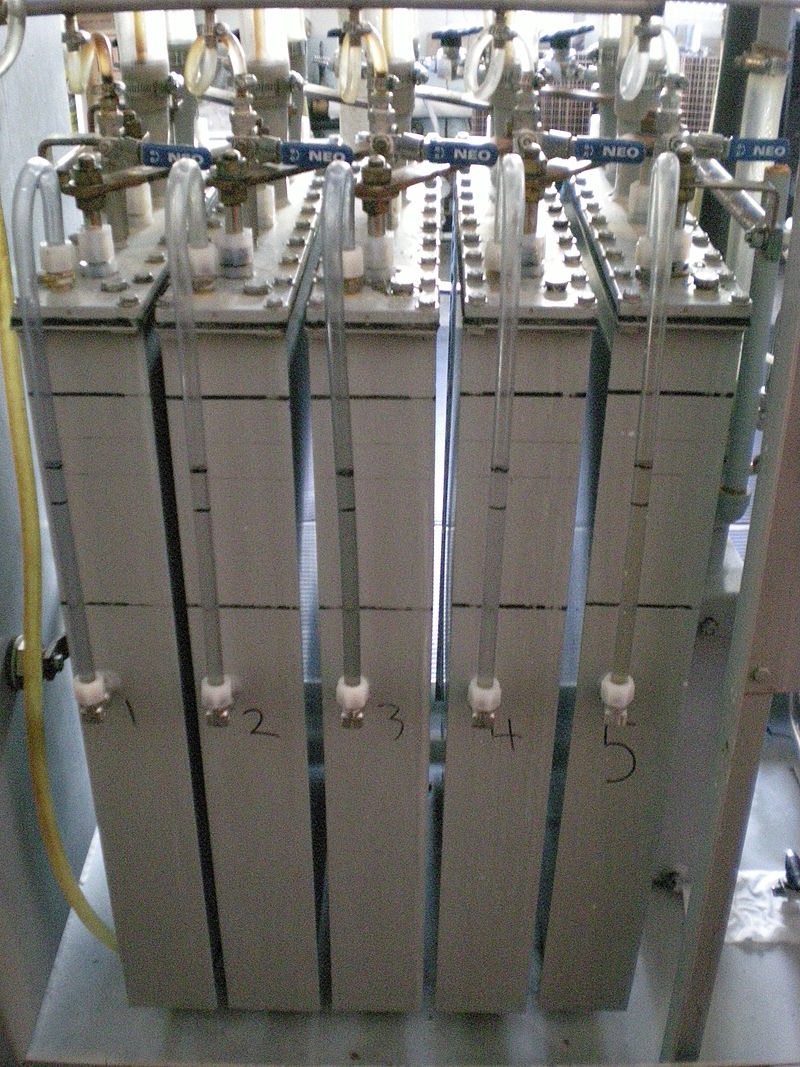
Modern electrolytic cell for hydrogen production (Source: Wikipedia)
Another big problem is, the conversion of electrical energy into hydrogen comes not without losses. Depending on the details of the process, we end up with 20-30% loss of energy, a significant problem.
Distribution of Hydrogen
Transportation of hydrogen is preferably done by gas pipelines. A well-known technology from natural gas, although not with the same efficiency, due to the very low density of the energy in even compressed hydrogen gas. Another problem is, hydrogen is a tiny molecule that can travel even trough metal grids, so special care is necessary to use the right materials.
Today, no country has a large hydrogen pipeline grid, resulting in the problem, it has to be built from scratch. And a pipeline grid is expensive!
Using Hydrogen
At the end of the pipe, hydrogen has to be used in power consuming applications. The simple way to use it is to burn hydrogen. It generates clean heat, only water is emitted into the air. Sounds perfect, but it doesn't make any sense because using the electricity that generated the hydrogen could have been used in a radiator, this would be not only more energy efficient, it is also less dangerous.
Hydrogen engine in a BMW (source Wikipedia)
Cars can use hydrogen as clean fuel. A slightly modified combustion engine can burn hydrogen, emitting water, and some toxic nitrogen oxides, therefore we still need a catalyst at the exhaust pipe.
Another problem is the very low efficiency of a combustion engine, somewhere at 25% of the energy in the hydrogen reaches the road to accelerate the car. Resulting in a very low overall efficiency if we start with electricity. Compare this result to a Li-Ion battery, where about 90% of the energy reaches the road and as a bonus, we can reuse the energy when we brake to charge the battery again!
Another idea is, to convert the hydrogen back to electricity, whenever needed. This is possible, using a fuel cell. The sad thing about this part is, it comes again with a high-cost due to the expensive precious metals and with more loss of energy during conversion.
Is Hydrogen the Future?
Summing up all these points, today, an electric grid with pumped hydro and batteries in mobile applications seems to be the better solution for the rising age of the renewable energy world.
But there is always research and no one can predict if there is a breakthrough in technology. But this is not only true for hydrogen technologies, it is also true for batteries, pumped storage, e.g. the Hydraulic Rock Storage seems to be one, and many other technologies.
Comment by Elon Musk to hydrogen
Confusing Hydrogen and Hydrogen
It should be mentioned, that there is a technology of nuclear fusion, using hydrogen to produce nuclear power. This path of research was not very promising until today, although an interesting new path, low energy nuclear reaction, commonly known as cold fusion might be a very disruptive technology, this is another story.
We live in a world, where the energy we consume was stored eons ago by nature. The conversion efficiency of solar energy into oil was really lousy, only a fraction of the solar radiation was converted to biological mater, only a fraction was laid down into the ground and only a fraction is now available. If we do the math, we find, that less than one billionth (10E-9) of the solar energy, which reached the earth within the last 100 million years, is stored in our fuel resources. This leads to the idea that we can do better than nature! Using solar radiation energy conversion systems like photovoltaic or concentrated solar power, we end up near 20% conversion rate, which is sufficient for economic land use and by a factor of 100 better than plants, who only convert 0.1% of the energy in usable fibers or sugar. It should be mentioned, plants need water and solar cells love deserts! Resulting in no competition of land use if we are smart and don’t plant for energy but plant for food.
The Storage Problem Remains
There remains a problem, storage! Storage was never an easy business, but if solved it changed the world. Inventing hey, for example, was necessary to conquer the northern hemisphere, where in wintertime is no food for the livestock. Storing information in books was the breakthrough for the industrial age and unlimited computer storage capacity is essential for our information age. The upcoming renewable power age lacks efficient and cheap storage capacity for electricity. Knowing this, we could visit the known technologies and there potential to solve the problem if further developed. Best known to the public are batteries. This is, by the way, a big problem, because our politicians, driven by their simple mind and the public, believe in batteries. Batteries are fine for mobile applications like cell phone and laptop. Cars using batteries are still expensive, but it may be within the reach of our technology to power them by batteries. Things get much more difficult if we want to use batteries for grid-scale applications. Batteries are expensive and need some more or less rare and expensive metals, they use processes which are not perfect rechargeable, this is the reason that batteries run out of business after a few thousand charging cycles. All this does not matter, if we use a mobile phone, live time is limited, the price of the battery is not the main value of the device and we don’t care to much on the environmental impact on the small scale that is involved.
Grid-Scale Storage is Different
If we need storage for large scale, and grid technology is always about GW and TWh, values, which are trillion (10E12) times above the mobile phone and laptop scale. This is, by the way, easy to guess, as long as billions of consumers are out there. There are three different questions, how expensive is the storage capacity, how many times can we recharge it, and how efficient is the process. The reason why price matters is we can only earn a limited amount of money on every charging cycle. If the battery life is already finished, before we have earned enough money to pay for the battery itself, it is useless to buy the battery at all. The situation for the efficiency is in some way similar. If we have to pay more for the energy to charge the battery as we earn during discharge, the system doesn´t work either. The problem of efficiency is not the core problem of batteries, but of many other storage concepts. Batteries suffer from the price per storage capacity.
Why Batteries don´t Work
Price of storage capacity for many batteries is above 200$/kWh, even for the very simple and widely used lead-acid battery. Lithium-based systems are often above 1000$/kWh although prices were dropping during the last two decades. Let´s do a simple calculation; our battery should be charged every day, as it makes sense in solar power systems. During nighttime, the price of power should be 10ct/kWh more expensive as at daytime. If we discharge the battery, we earn 10ct every day and within six years we have a return on our investment into the lead-acid battery. But this does not hold due to the fact, that our battery dies after about 1000 cycles. Using the Lithium system, things are even worse, we have to wait about 30 years for the return of our invest without any interest rate, this does not attract many investors.
More Storage Technologies
We visit other techniques of storage in the next blog posts